Permit Test vs Driver Test: Key Differences Explained
Published November 16, 2026 · 8 minute read
The permit test vs driver test question is easier once you separate knowledge from performance. The permit test checks what you know about traffic laws and safe decisions. The driver test, usually called the road test, checks what you can do behind the wheel. Applicants complete the written stage first, then meet their state's practice or waiting rules before scheduling the road test.
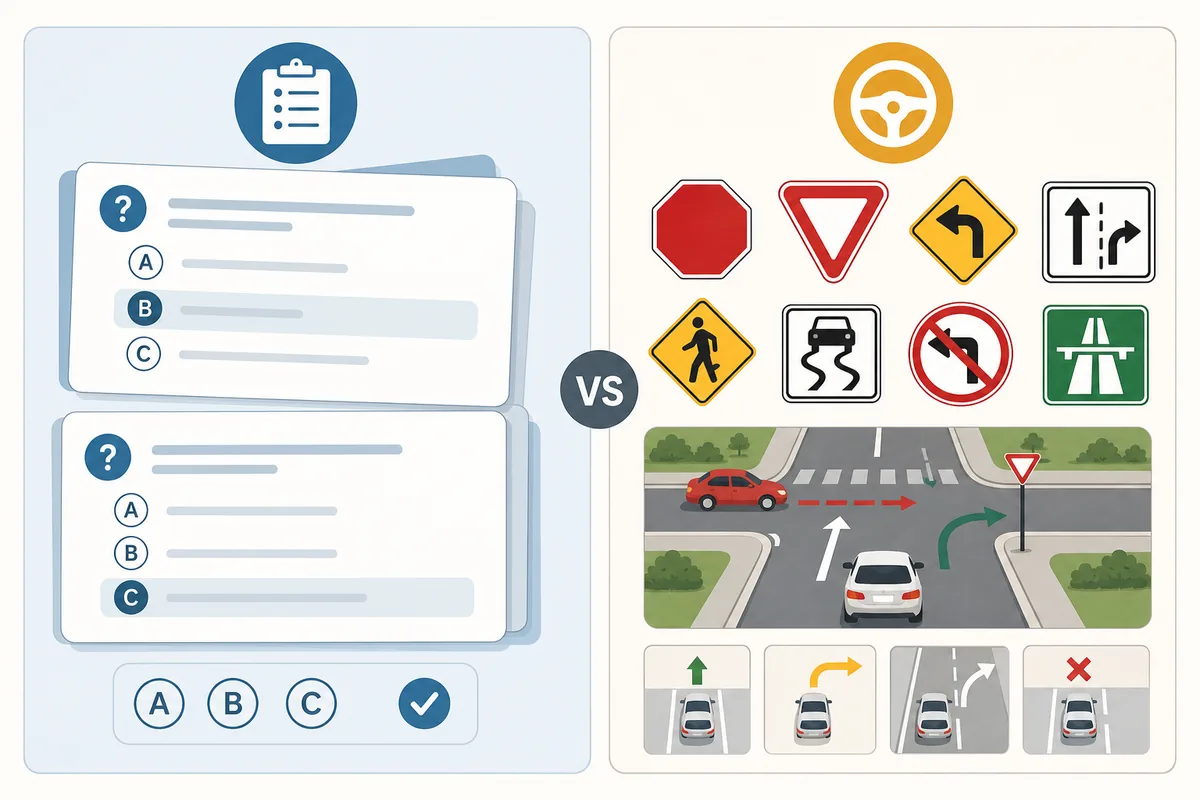
What the permit test measures
The permit test is the written knowledge test that usually comes before supervised driving. It asks whether you understand the rules you will need to follow while learning: traffic signs, right of way, speed control, lane use, signaling, safe following distance, impaired driving, and responses to hazards. Some agencies call it a knowledge exam, written test, learner permit test, or DMV permit test. The label changes, but the job is the same: confirm that you can make safe decisions before you drive with a permit.
Most versions use multiple-choice questions on a computer or paper form. The number of questions and required score are state-specific, so do not copy a benchmark from a different state. For a broader question-count comparison, see the state-by-state permit test question guide. The current driver handbook remains the best source for wording, signs, penalties, and special rules.
Preparation is mainly reading, retrieval, and correction. Read a handbook section, answer practice questions, explain why an option is safest, and return to the source when you miss one. Our free DMV permit practice test can help you find weak topics, but practice results are not an official eligibility decision.
What the driver test measures
The driver test is the behind-the-wheel road test. An examiner sits in or near the vehicle and scores observable behavior in a controlled route or test area. You may be asked to show basic vehicle functions, start and stop smoothly, check mirrors and blind spots, signal, change lanes, obey signs, manage turns, control speed, and respond to traffic. The examiner is judging safe habits and awareness, not just whether you can move the car.
Road-test preparation is physical and situational. Practice scanning before moving, making an obvious head check when required, leaving space around vulnerable road users, and choosing a speed that fits visibility and conditions. Ask your supervising driver to give specific feedback instead of simply saying that the drive was good. A state may also require a safe, registered, insured vehicle with working lights, brakes, belts, mirrors, horn, and wipers.
Official instructions show why road tests cannot be reduced to a written score. South Carolina describes vehicle equipment checks, a vision test, and an on-road portion, while New York explains that a road-test appointment and a learner-permit holding period can depend on age. Read your own agency's instructions before you schedule.
Permit test vs driver test comparison
Use this table as a mental model, not as a substitute for state rules. The same applicant may take both exams, but they measure different evidence and require different preparation.
| Question | Permit test | Driver test |
|---|---|---|
| Main purpose | Check knowledge of laws, signs, and safe decisions. | Check practical control, observation, communication, and judgment. |
| Typical setting | Computer, kiosk, or written station at an agency or approved provider. | Test vehicle on a public-road route or designated course with an examiner. |
| Preparation | Driver handbook, topic review, and practice questions. | Supervised driving, maneuvers, traffic observation, and vehicle checks. |
| Result | May issue or advance a learner permit when other application steps are complete. | May demonstrate road-test readiness for a driver license when all conditions are met. |
| Common failure pattern | Memorizing an answer without understanding the rule or missing state-specific wording. | Late observation, weak lane control, unsafe gaps, missed signals, or an unready vehicle. |
| State variation | Questions, languages, scores, fees, and retakes vary. | Holding periods, route skills, vehicle standards, scheduling, and retakes vary. |
Which test comes first, and how long between them?
For a typical first license, the permit test vs driver test sequence is: application and vision screening, permit test, learner permit, supervised practice, then driver test. Passing the written exam does not automatically authorize an unsupervised road test. Many states require a minimum permit-holding period, supervised hours, driver education, or an age-based condition before you can book the road test.
The waiting period is not universal. New York, for example, tells applicants under 18 to wait at least six months from the learner-permit date before scheduling a road test. South Carolina describes a different minimum period for younger and adult applicants. Arizona's permit page also states that a permit test comes before scheduling a road test. These examples explain the order, but your agency controls the rule that applies to you.
Adults and people transferring a license may have a different path. Previous license history, an expired credential, a foreign license, a motorcycle or commercial class, or an approved course can change what is required. Check the exact applicant category rather than assuming that a friend's teen timeline applies to you.

A two-stage study plan
A good permit test vs driver test study plan keeps the exams separate while connecting them in the right order. Do not memorize a universal score or promise a first-attempt pass. Build evidence that you know the rules and can apply them safely.
- Identify your state and credential. Start with the official agency page for a standard learner permit or first license. Note whether you are a teen, adult first-time applicant, transfer applicant, or motorcycle or commercial learner.
- Save the current handbook and forms. Bookmark the handbook, application, document list, fee page, testing instructions, and road-test page. Record any update date, because fees, test channels, and required forms can change.
- Study the written exam first. Read signs, right of way, lane rules, speed control, and hazard-response sections. Take short practice sets, review every missed answer, and write the rule in your own words. Use the permit test practice hub for review, not as a replacement for the handbook.
- Complete the permit steps. Follow the agency's instructions for vision screening, identity documents, payment, the knowledge test, and permit issuance. Keep receipts or confirmation numbers and ask about retake timing if you do not pass.
- Practice the road skills deliberately. With an eligible supervisor, work on mirror checks, blind spots, lane changes, turns, stops, parking, speed choices, and calm responses to unexpected traffic. Repeat the route only after the underlying skill is reliable.
- Run a final vehicle and document check. Before the appointment, verify registration, insurance, lights, belts, mirrors, wipers, and any required permit or course record. Then confirm the exact arrival time, location, and road-test cancellation policy.
Common mistakes and a test-day checklist
The most common mistake in a permit test vs driver test search is treating one passing result as proof that the other stage is complete. A strong knowledge score does not show that you can observe traffic while steering. A comfortable practice drive does not guarantee that you know the legal rule used in a written question. Track the two readiness signals separately.
- Bring the documents, permit, glasses, payment method, and confirmation details listed by the agency.
- Use the current handbook for legal wording and your state's practice material for topic review.
- Do not book the road test until you have confirmed the minimum permit period, supervised hours, education, or adult exception that applies to you.
- Use a legal, safe, insured vehicle and check its basic equipment before leaving home.
- If you fail, write down the specific topic or driving behavior to correct and read the official retake rule before choosing another date.
For identity and application paperwork, use the site's DMV document checklist. For state-level eligibility and testing differences, use the permit test by state guide. The article about an online permit test covers location and device rules separately.
Permit test vs driver test FAQ
Is the permit test the same as the driver test?
No. The permit test is a written knowledge exam. The driver test is a behind-the-wheel road exam that evaluates how you operate a vehicle and respond to traffic.
Which comes first?
Usually the permit test comes first, followed by a learner permit and a state-defined practice or waiting period. Check the agency page for adult, transfer, motorcycle, and commercial exceptions.
Do I need to study for both tests?
Yes. Use handbook and question review for the written stage, then use supervised driving and specific feedback for the road stage. Neither type of practice replaces the official exam.
Can I take the road test without a learner permit?
Some states provide limited adult or prior-license exceptions, but many require a permit or another eligibility condition. Confirm the rule before scheduling or paying a road-test fee.
What happens after a failed attempt?
Read the official retake rule, identify the missed knowledge topic or driving behavior, and practice that gap. Retake limits and waiting periods can differ between the permit and driver tests.
Sources and scope
This comparison uses terminology and process examples from official Arizona DOT permit testing, South Carolina DMV road testing, New York DMV road-test scheduling, Pennsylvania's driver manual, and the California DMV testing process. Agency rules change. PermitTestPro is an educational publisher, not a DMV, and this article does not replace the current handbook, application instructions, or official appointment page for your state.