State-Specific Permit Test Requirements: PA, OH & MA
Updated October 12, 2026 · 8 minute read
State-specific permit test requirements are different in Pennsylvania, Ohio, and Massachusetts. This regional guide compares the documents, knowledge-test format, score targets, and preparation steps that matter before you book an appointment. It is a planning aid, not a substitute for the current manual issued by your state.
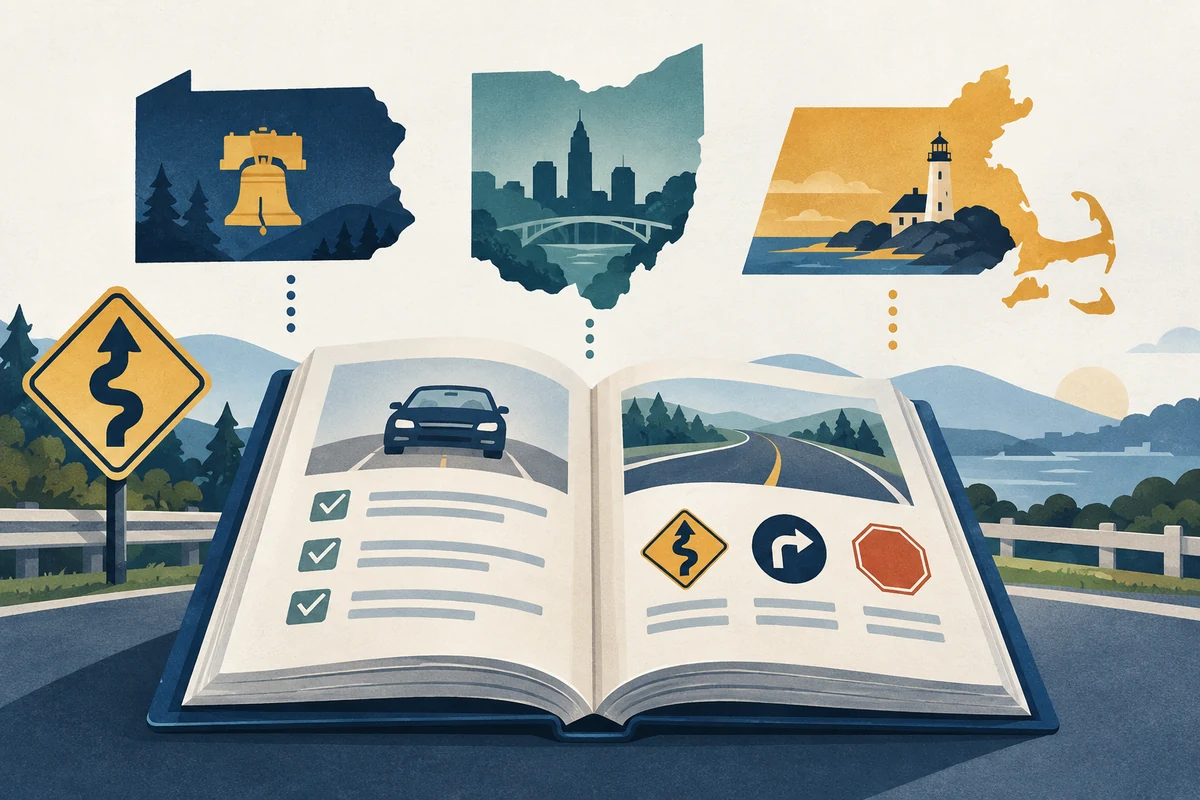
State-specific permit test requirements at a glance
Use the table to choose the right starting point, then open the official link for your state. The question and score figures are practical study benchmarks drawn from the site's state resources; they are not a promise that a future exam will use identical wording.
| State | Study format | What to prepare | Best next step |
|---|---|---|---|
| Pennsylvania | 18-question Class C knowledge format; 15 correct is the common pass benchmark. | Identity and residency evidence, vision screening, payment, and any minor-consent or education forms. | Read the PennDOT learner permit instructions. |
| Ohio | 40-question temporary-permit format; 30 correct is a useful 75% practice target. | Ohio identity and residency documents, vision screening, and the current BMV driver manual. | Review the Ohio temps practice test, then check Ohio BMV. |
| Massachusetts | 25-question Class D study format; 18 correct is the page's readiness target. | RMV application documents, lawful-status and residency proof, fee, vision screening, and the Driver's Manual. | Use the Massachusetts permit practice test and the Mass.gov instructions. |
Why state rules differ even when the topics look familiar
All three tests draw from the same broad ideas: signs, signals, right of way, safe speed, lane use, sharing the road, and impaired driving. The administrative path is where many applicants lose time. A state may use a different credential name, separate sign sections, a different score rule, or a different appointment and payment workflow.
1. The credential and applicant category
Teen applicants, adults, motorcycle riders, commercial learners, and people moving from another state may not use the same application. Before studying, identify the exact credential and your age group. A general learner-permit article can explain the vocabulary, but the agency page for that credential controls.
2. Documents and screening
Identity, lawful status, Social Security information, residency, a name-change record, payment, and a vision check appear often, but the accepted documents and combinations are state-specific. Minors may also need a parent or guardian signature, driver education proof, or a supervised-hours form. Put your document checklist beside your practice score so a high score does not create false confidence.
3. Question design and passing rules
A 75% result in one state is not automatically the right goal in another. Some agencies publish one total score; others divide road signs and general knowledge. Practice with the state page's format, but learn the rule behind each answer rather than memorizing a number.
Pennsylvania permit test requirements
Pennsylvania applicants usually begin with a learner's permit application and a knowledge test based on the Pennsylvania Driver's Manual. The standard Class C format is commonly described as 18 multiple-choice questions, with at least 15 correct needed to pass. Treat that figure as a current study benchmark and confirm the version listed by PennDOT before your appointment.
Prepare identity, lawful-presence and residency evidence, Social Security information when required, payment, and the forms that apply to your age. A minor may need parent or guardian consent and a driver-education or school form. If your legal name has changed, bring the accepted link between the old and new name instead of assuming a school ID is enough.
For study, separate signs from rules. Pennsylvania questions often reward precise reading of right-of-way, speed, lane positioning, work zones, and sharing the road. Keep a missed-question log with the handbook chapter that resolves each miss. The broad permit test by state guide is useful for your first checklist; this regional page narrows the comparison to three neighboring applicant paths.
Ohio permit test requirements
Ohio's temporary instruction permit process is commonly practiced as a 40-question knowledge test with a 30-correct, or 75%, benchmark. The Ohio practice page on this site mirrors that size and gives an explanation after each answer. It is an independent study tool, so use the current Ohio BMV manual and testing-provider instructions for the official process.
Ohio preparation should include signs, traffic laws, right-of-way, safe following distance, school zones, railroad crossings, impairment, and temporary-permit responsibilities. Keep your documents ready as well: identity, Ohio residency, lawful status, and vision requirements can be checked separately from the knowledge score. An online option, if available for your applicant category, may have identity checks or follow-up steps that a walk-in appointment does not.
Before booking, take two mixed practice runs without looking up answers. A 30/40 score is the floor for planning; a stable score in the mid-30s with no repeated topic gap is a safer signal that you have learned the material.
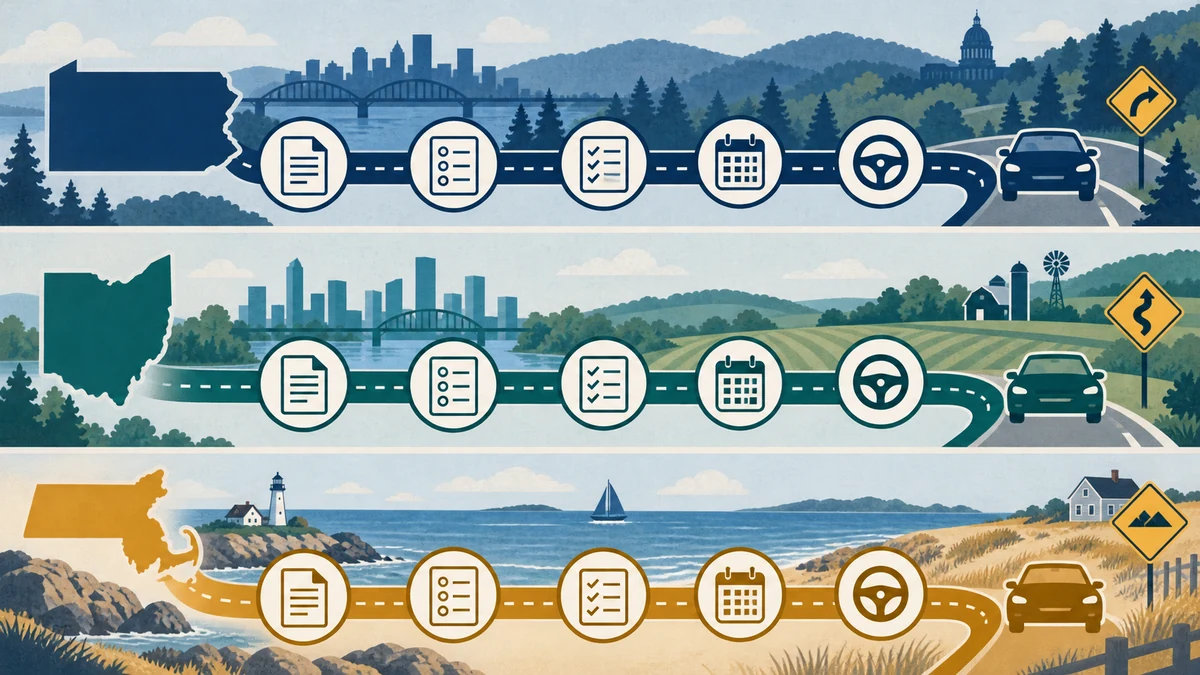
Massachusetts permit test requirements
Massachusetts Class D applicants use the RMV's learner-permit process and the Massachusetts Driver's Manual. The study format on this site uses 25 questions with an 18-of-25 readiness target. Check the current Mass.gov instructions and exam overview for the official question count, fee, identity checks, and testing channel because the agency can revise procedures.
Massachusetts preparation benefits from careful scenario reading. Review signs, safe driving, sharing the road, right-of-way, speed management, and the state-specific language used in the manual. The Massachusetts practice test provides original questions and explanations; use each explanation to locate the relevant manual section instead of memorizing the answer order.
Document planning is just as important as studying. Compare the RMV list for identity, lawful status, Social Security information, Massachusetts residency, payment, and any parent or guardian requirements. If you are an adult applicant or have a name-change record, verify the accepted combination before you reserve a test slot.
How to verify state-specific permit test requirements
- Name the credential. Write down learner permit, Class C, temporary instruction permit, Class D, motorcycle, or commercial learner permit before you open a practice quiz.
- Open the current agency page. Use PennDOT, Ohio BMV, or Mass.gov rather than a social post. Look for a revision date, downloadable manual, or application checklist.
- Separate score facts from appointment facts. Record question count and pass rule in one column, then documents, fee, vision screening, location, online eligibility, and retake rules in another.
- Build your document folder. Save the appointment confirmation, identity and residency proofs, payment method, consent or education forms, and name-change evidence that applies to you.
- Recheck shortly before testing. State agencies can change fees, providers, hours, and online eligibility without changing the driver manual's traffic-law chapters.
For a broader checklist, read what to bring to the DMV and the permit test appointment guide. Those pages explain common preparation; your state agency remains the controlling source.
A seven-day study plan for all three states
Use a short loop that combines official reading with state-matched practice. The schedule works whether you are preparing for Pennsylvania, Ohio, or Massachusetts because it separates legal facts from test-day administration.
| Day | Focus | Action |
|---|---|---|
| 1 | Requirements | Save the agency page, manual, document list, fee, and appointment rules. |
| 2 | Signs | Review shapes, colors, warnings, work zones, school areas, and railroad signs. |
| 3 | Rules | Study right of way, speed, following distance, lane changes, turns, and parking. |
| 4 | Baseline quiz | Take the correct state-format practice test without looking up answers. |
| 5 | Repair misses | Read the manual sections behind every wrong or guessed answer. |
| 6 | Mixed review | Retake a mixed set and aim above the benchmark twice, not just once. |
| 7 | Test-day check | Confirm documents, address, fee, appointment, permitted device, and arrival time. |
Common comparison mistakes
- Copying another state's number: Ohio's 40-question practice format does not tell you how Pennsylvania or Massachusetts scores a knowledge test.
- Using a generic document list: accepted proof and minor forms can change by state and applicant category.
- Studying only the quiz: third-party practice questions are prompts, not the official question bank. Read the manual behind each answer.
- Assuming online means official: confirm the approved provider, identity checks, equipment, and follow-up visit before paying.
- Skipping the final check: a passing practice score cannot fix an expired identity document or a missed appointment window.
FAQ: state-specific permit test requirements
Official sources to check
Use these first-party pages to confirm the final rules and download the current manual:
Bottom line
The useful way to compare state-specific permit test requirements is to separate three decisions: which credential you need, which documents your agency accepts, and which knowledge-test format you must study. Use the Pennsylvania, Ohio, or Massachusetts practice page for repetition, then verify the current agency checklist before you travel to the test.