Permit Test by State: State-Specific Requirements for Adults
Published October 23, 2026 · 9 minute read
A permit test by state: state-specific requirements for adult first-time drivers can affect more than the written exam. Your route may depend on whether you need a learner permit, approved driver education, a permit-holding period, or a particular document set before the road test.

How adult permit paths differ from teen rules
Many people search for adult permit requirements after turning 18, but age alone does not tell you whether you can skip the learner-permit stage. States set the sequence for each credential. The answer can also change based on whether you have held a license before, whether it was issued by another state or country, and whether you can provide proof of that history.
For a permit test by state, state-specific requirements should be checked separately from the written exam and adult first-license eligibility.
Separate two questions before you study. The first is about the knowledge test: which handbook and test apply to your credential? The second is about license eligibility: what must happen before you can drive, hold a permit, or book a road skills test? These steps can be related, but they are not interchangeable. Passing a written test does not by itself prove that you meet every adult education, document, or road-test condition.
Use the broad permit test by state comparison for general question formats and study planning. This guide narrows the question to first-time adult applicants. If you already held a valid license, are transferring from another state, or need a motorcycle or commercial credential, use the agency page for that specific route instead of applying the first-time-driver checklist automatically.
Official state examples: Virginia and Pennsylvania
When researching a permit test by state, state-specific requirements should stay tied to their issuing agency. This table compares only what the linked materials confirm; it is not a complete 50-state chart and does not assume one state's sequence applies elsewhere.
| State | What the official source says | What an adult should verify next |
|---|---|---|
| Virginia | For a first-time applicant age 18 or older who has never held a license, or cannot show proof of one, the DMV lists approved driver education or holding a learner permit for at least 60 days before the road skills test. | Confirm which option applies to your record, then use the DMV's current document guide and road-test instructions. |
| Pennsylvania | PennDOT's manual says a learner permit is required before operating a vehicle. Its application instructions describe vision and knowledge tests; applicants over 18 must present two proofs of residency, while the parent or guardian consent form is specified for applicants under 18. | Check the current DL-180 form, accepted residency documents, fee, test-center instructions, and road-test eligibility for your situation. |
These examples are useful because age changes more than the presence of a parent signature. Virginia states an adult prerequisite before the road skills test; Pennsylvania's instructions distinguish the documents adults must show. Always read the whole current agency page, because an excerpt or older checklist may omit a condition that applies to you.
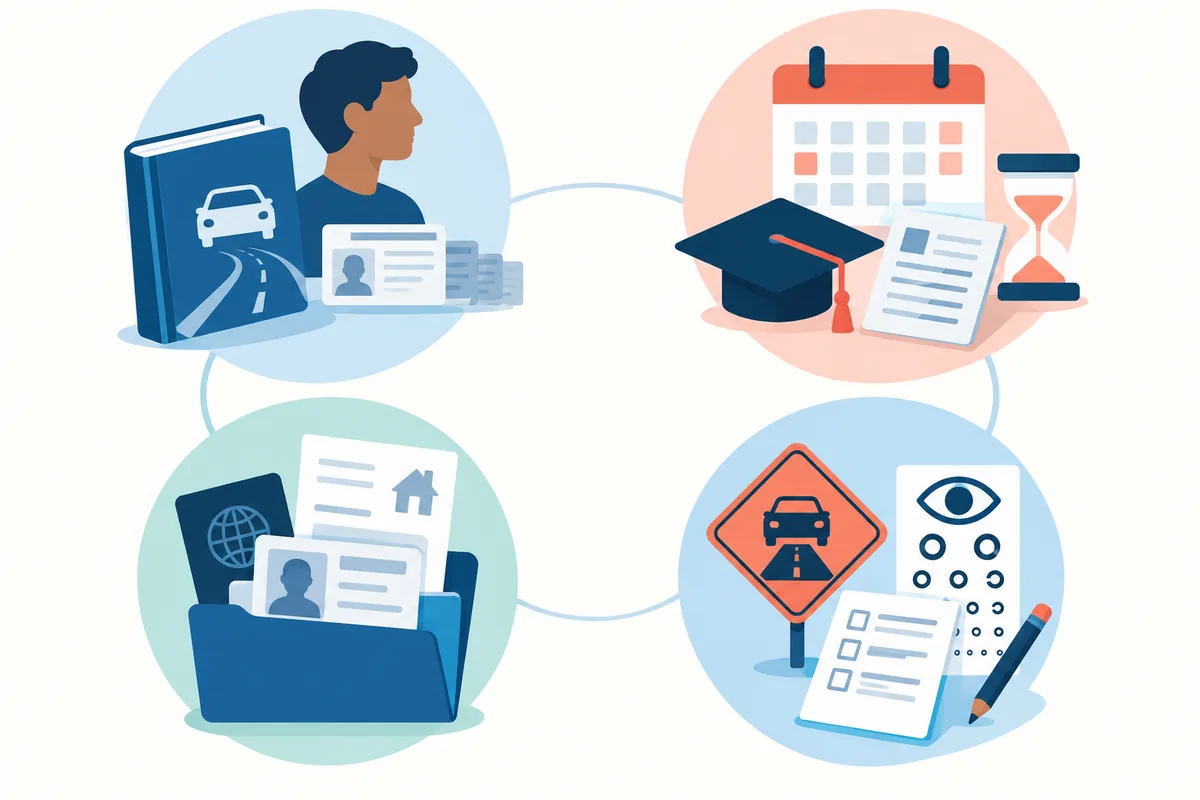
Five state-specific requirements to check before booking
Write down the answer to each item from the official licensing agency before paying a fee or choosing a test date. A saved page or note can help you avoid repeating the search when you gather paperwork.
- Credential and prior-license history. Confirm that you are applying for a standard noncommercial first license, not a transfer, renewal, motorcycle permit, or commercial learner permit. Check what proof the agency accepts if you held a license elsewhere.
- Permit requirement and use. Ask whether an adult must obtain a learner permit before practicing, before taking a road test, or both. Also check who may supervise practice and whether the permit has restrictions that apply to adults.
- Education or waiting period. Look for an adult driver-education requirement, an alternative to completing a course, or a minimum period of holding a permit. Record the exact condition and the point in the process when it must be met.
- Application and identity documents. Use the current document list for identity, lawful presence, residency, Social Security information, name changes, and any application form. Check the required number of proofs and whether originals or specific formats are needed.
- Knowledge, vision, and appointment details. Verify which tests you take, how to schedule, what payment methods are accepted, whether a separate road-test appointment is needed, and what happens if an application expires or you need a retest.
For a general packing list, see the site's DMV permit test document checklist. Treat it as a starting point only; your state's current adult application page decides which documents are accepted.
A practical plan for an adult first-time applicant
Once you know your state's conditions, keep the sequence simple. If a step is unclear, pause and ask the agency rather than relying on a general online answer.
1. Confirm the state and applicant category
Use the licensing agency for the state where you will apply. Choose the page for an adult first-time driver and the exact license class. If you moved recently, have an expired out-of-state license, or have a foreign license, check whether that changes your application path.
2. Save the official rules and forms
Download or bookmark the current handbook, application, document list, fee schedule, and appointment instructions. Record the page's update date if shown. Do not assume a third-party practice page includes every eligibility condition or that a form used by a teenager is right for an adult.
3. Study the matching knowledge-test material
Read the state driver handbook before taking practice questions. Use a state-matched quiz to find weak topics, then return to the exact handbook section for signs, right-of-way, lane use, or other missed rules. The site's permit test practice can support review, but it is not an official exam or proof of eligibility.
4. Complete the required tests and application steps
Bring the documents in the format the agency asks for and follow its instructions for vision screening, the knowledge test, fees, and permit issuance. Keep receipts or confirmation numbers. If the state requires a course or a permit-holding period before the road test, keep the completion record and note the date the condition is satisfied.
5. Verify road-test readiness separately
Before scheduling, check the road skills test page for minimum holding time, education proof, vehicle rules, insurance, appointment availability, and any restrictions that remain in effect. A permit test score and road-test eligibility answer different questions, so verify both.
Assumptions that can delay an adult permit application
- "I'm over 18, so I can go straight to the road test." Some states still require a permit or another prerequisite. Confirm the rule for first-time applicants.
- "Adults never need driver education." Education requirements can have adult-specific conditions or alternatives. Read the age 18+ section directly.
- "A teen checklist is close enough." Parent consent, residency evidence, holding periods, and supervision rules may differ by age. Use the adult application list.
- "A practice test proves I can apply." Practice helps with study, not legal eligibility. The state agency decides accepted documents, test steps, and license issuance.
When official pages disagree or leave a detail unclear, contact the licensing office before booking. Keep the answer and the date you checked it with your application papers.
Adult permit test FAQ
Do you need a learner permit if you are over 18?
It depends on your state and driving history. Pennsylvania says a learner permit is required before operating a vehicle. Virginia describes an adult route where approved driver education or holding a permit for at least 60 days can satisfy a prerequisite before the road skills test for certain first-time applicants. Check your own agency's current instructions.
Is the permit test different for adults?
The written knowledge exam may draw from the same state handbook, but age can change the application sequence, education condition, documents, or road-test eligibility. Verify the correct first-time adult category before studying.
Can an adult skip driver education?
Do not assume so. Virginia lists approved driver education or a 60-day learner-permit holding period for certain adults who have never held a license or cannot prove prior licensure. Other states can set different conditions.
What documents should an adult bring to the DMV?
Start with the agency's current list for identity, lawful presence, residency, Social Security information, and the application form. Pennsylvania's manual says applicants over 18 need two proofs of residency. Accepted documents differ by state.
Can adults take the road test without taking a permit test?
That depends on the state, the applicant's prior license history, and any education or permit-holding condition. Ask the agency which knowledge tests and eligibility steps apply before reserving a road-test appointment.
Where should an adult study for a permit test by state?
Use the current state driver handbook as the source of truth, then take practice questions that match that state. Review each missed answer in the handbook instead of memorizing a third-party answer key.
Bottom line
For an adult first-time driver, the permit test by state is only one part of the application. Confirm your prior-license category, permit requirement, adult education or holding-period rule, documents, tests, and road-test eligibility with the issuing agency. Then use state-matched practice to prepare for the knowledge exam.
Official sources checked
Sources checked October 23, 2026. State rules can change; confirm the latest instructions with the agency that issues your credential.